
Paper or digital business card: a plain comparison
What each kind of card does well, and where paper still earns its place.
Free 30-day trial, no credit card. Ordering for a whole team? Talk to us
A paper business card is simple and needs no phone, but it is fixed once printed, and you only get someone's details if they give you their own card. A digital business card such as Exchange, from Klobbi, is shared by QR code or link, changes when you edit it, and can collect details that people choose to share.

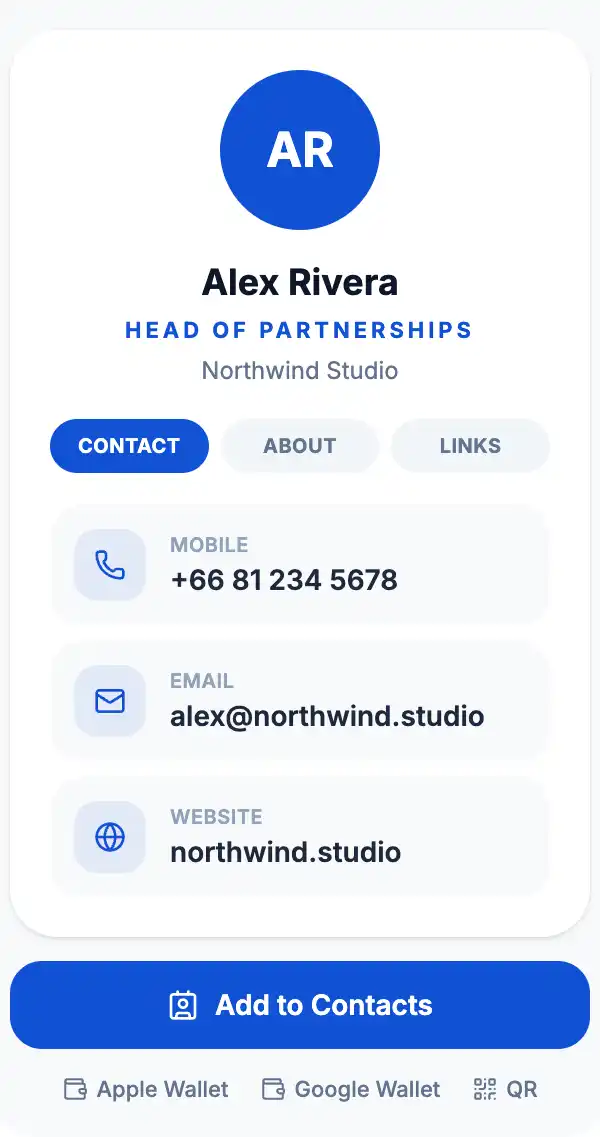
How do paper and digital business cards differ?
Both hand over your name and contact details. The difference is in what happens before and after that moment.
| Compared on | Paper card | Exchange digital card |
|---|---|---|
| Sharing | Handed over in person | QR code or link; opens in any web browser |
| Updating details | Order a new print run | Edit the card: the page changes at once, saved wallet passes refresh on their own, and the QR code and link stay the same |
| Getting the other person's details | Only if they give you a card | Optional lead capture: visitors can enter a name and email to unlock your card |
| Follow-up | You type the details in yourself | Contacts land in a workspace with a pipeline, notes and reminders |
| Where it lives | Wallet, pocket or desk drawer | Apple Wallet or Google Wallet pass; people who unlock your card can find it again by signing in |
When does a paper card still make sense?
- You rarely meet new people and your details hardly change.
- The other person prefers paper or has no phone at hand.
- You want a backup for when your phone battery runs out.
- You simply like a well-printed card, which is a fair reason.
Paper is not the wrong choice. Its limits are easy to state: a printed card cannot be updated, and it does not bring you the other person's details.
When is a digital business card the better fit?
A digital business card, or e-business card, earns its keep when you meet many people, change jobs or numbers, or want to follow up properly. With Exchange, your details stay current without reprinting, and lead capture can put the details of people who choose to share them straight into your workspace.
In Bangkok, where a single trade show or conference week can leave you with a long list of new contacts, that difference shows quickly. For what to do afterward, read our business card follow-up guide.
Can you use both?
Yes. Some people keep a small stack of printed cards and share a digital card the rest of the time. You can also download or print your Exchange QR code for a paper card or a sign, so the printed card leads to the digital one.
How can you try a digital business card?
Ask us for a 30-day free trial of Exchange, Klobbi's digital business card; our Bangkok team sets it up, with no credit card needed. You get one card in your own design, wallet passes, lead capture, saved cards and a workspace with a pipeline and reminders. After the trial, Exchange costs ฿500 per user per year in Thailand, and our Bangkok team can answer questions in Thai or English.
Frequently asked questions
Does a digital business card look more professional than a paper one?
The format matters less than whether your details are correct and easy to save. A digital card can be updated the moment something changes; a paper card has to be reprinted.
Do I reprint anything when my Exchange details change?
Not for your digital card. Your Exchange QR code and link stay the same, and the card page updates as soon as you edit it.
Can people save my digital business card to their phone?
Yes. An Exchange card has an Add to Contacts button that saves your details to the other person's phone in one tap.
Can I use paper and digital business cards together?
Yes. Some people keep a few paper cards, for example as a backup for a dead phone battery, and share a digital card most of the time.
How much does a digital business card cost in Thailand?
Exchange costs ฿500 per user per year after a 30-day free trial with no credit card. For the Teams plan, talk to us.
Does the other person need an app to open a digital business card?
No. An Exchange card opens in any web browser, so the person you meet needs no app.
Talk to us about moving your team to digital cards
Use this form to request your 30-day free trial or to ask about the Teams plan. Our Bangkok team sets up your trial, and no credit card is needed.
If your company is thinking about replacing or supplementing printed cards, tell us about your team and we will help you plan the switch.
We reply by email within one working day.
Prefer chat? Use the LINE or WhatsApp button at the side of this page, or message us on WhatsApp at +65 8836 2597. You can also write to sales@klobbi.com.
It helps to tell us:
- How many people need a card
- How you use printed cards today
Add a digital card to your paper ones
30 days free with no credit card.