
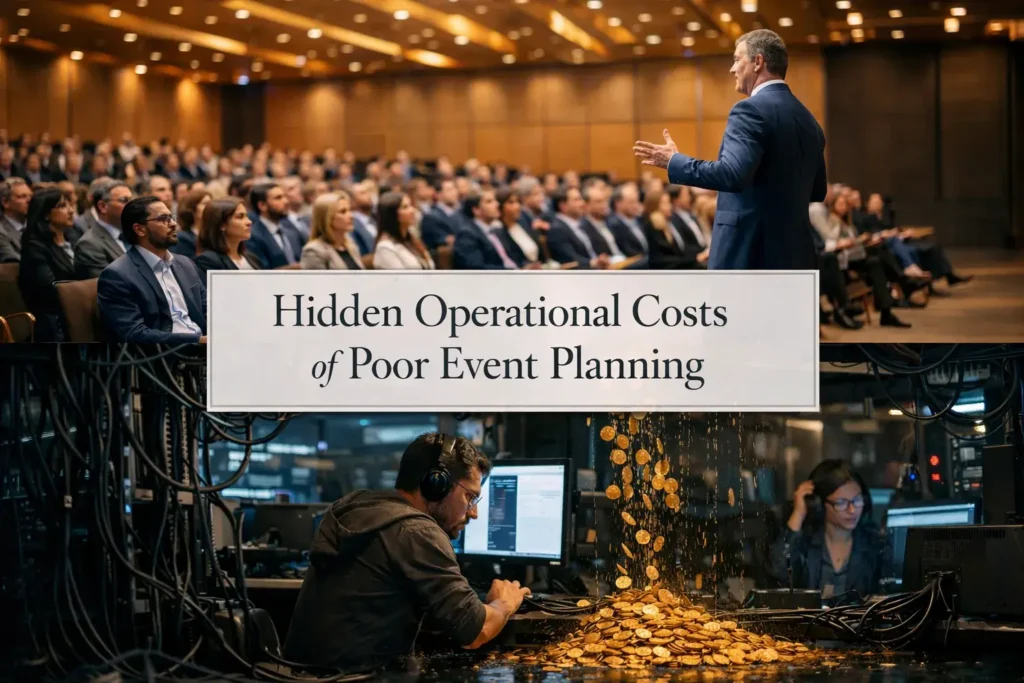
Poor event planning does not just cause budget overruns. It generates a quieter, more damaging kind of cost — operational drag that shows up as overtime invoices, rush reprints, venue penalties, staffing gaps, and hours of post-event reconciliation that nobody budgeted for. This article breaks down the seven hidden operational cost buckets that erode event margins, and gives you a practical framework to prevent them.
Most event planners know what a budget overrun looks like. Catering comes in 12% over estimate. The AV quote climbs after the production brief changes. These are visible, line-item problems — painful, but trackable.
Operational costs are different. They are the time, labour, and money your team burns running the event that never appears cleanly in a forecast. The three hours a coordinator spends manually exporting attendee data between systems. The last-minute badge reprint when a speaker’s name was entered incorrectly. The venue overtime charged because check-in queues ran 40 minutes longer than planned.
These are not line items. They are workflow breakdowns that turned into invoices — and because they were never planned for, they are almost always avoidable in hindsight.
Understanding the difference between a budget overrun and operational cost leakage is the first step to addressing it. Budget overruns require better estimation. Operational inefficiencies require better process.
The hidden operational costs of poor event planning tend to cluster into seven recurring categories. Each one has a predictable trigger, a predictable consequence, and — importantly — a predictable prevention.
A speaker swaps their presentation format from panel to keynote three days before the event. A session gets rescheduled after the programme was already sent to print. The sponsor’s logo needs updating on the main stage backdrop.
Each of these is a change order — and outside of your contracted timeline, vendors charge rush fees for the privilege. Reprinting signage, reconfiguring AV, updating registration confirmation emails, and revising the run-of-show all carry a real cost when they happen under time pressure.
Event timelines slip. Builds run long. Registration queues extend beyond the allocated window. When they do, staff on hourly rates clock overtime — and if your on-site team is under-resourced for the actual workload, you call in temp staff at short notice, often at a premium rate.
The root cause is rarely a staffing shortage. It is almost always a run-of-show that was not stress-tested against realistic task durations — or a check-in process that relied on manual lookup instead of a structured system.
Venue contracts carry clauses that are easy to underestimate when you are focused on the headline room rate. Service charges of 20–25% on F&B spend are standard in Singapore’s hotel venues — and they appear on the final invoice, not the proposal. Attrition clauses set a minimum spend or headcount guarantee; fall short, and the venue charges a penalty to cover the shortfall.
F&B minimums, Wi-Fi provisioning costs, A/V patch fees, rigging charges, and overtime for venue operations staff are all legitimate costs that are negotiable before signing — and near-impossible to dispute after.
When registration, abstract management, speaker communications, catering, and badge printing are managed across four or five separate tools with no connection between them, data has to be moved manually. Someone exports a CSV from the registration platform, formats it, and uploads it to the badge printing system. Someone else reconciles the abstract acceptance list against the registration records to confirm speaker status.
Every manual data transfer is a potential error — and every error generates rework. A name entered incorrectly flows through to a misprinted badge, a wrong session allocation, and a frustrated delegate at the registration desk on the morning of the event.
Printed materials, branded merchandise, signage, exhibition materials, and technical equipment all have to get to the venue. Shipping, storage, on-site receiving, and drayage (particularly relevant for trade shows with exhibition components) are costs that accumulate in ways that are hard to forecast line-by-line at the planning stage.
Last-minute print orders — triggered by change orders or delayed approvals — typically carry a rush premium of 30–60% over standard turnaround pricing. On-site printing at the venue is more expensive still.
Check-in bottlenecks are among the most visible operational failures at conferences — and among the most predictable. When registration queues extend into opening session time, three costs accumulate simultaneously: additional staff are needed to manage the queue, the opening session is delayed, and venue technicians on hourly rates wait for the session to begin.
Check-in delays also affect attendee satisfaction in ways that are disproportionate to their actual duration. A 15-minute queue at the start of an event sets a negative tone that influences NPS scores regardless of everything that follows.
Permits, public liability insurance, food handling licences, and safety planning are not optional for events of any meaningful scale — but they are routinely treated as afterthoughts that get sorted “closer to the time.” When they are not budgeted and planned from the start, they generate last-minute procurement costs and, in some cases, event insurance premiums inflated by late application.
Data privacy is increasingly relevant for Singapore organisers. Collecting attendee registration data, dietary information, and payment records without a clear data handling process exposes your organisation to compliance risk under the PDPA — and rectifying a data governance gap after registration has opened is significantly more disruptive than building it in at the start.
Operational cost leakage rarely announces itself. It builds quietly through small process failures that nobody addresses because individually they seem minor. These are the signals worth watching for in any event planning cycle:
If three or more of these apply to your current event cycle, the hidden operational costs of poor event planning are almost certainly already materialising. The question is whether they show up before the event — where they can be managed — or on the final invoice, where they cannot.
Running abstract submissions alongside conference registration? Streamlining approvals and workflows across your submission and review process eliminates one of the largest sources of manual rework in academic and medical conference planning.
None of the seven cost buckets above require sophisticated technology to address. Most are process failures — and process failures have process solutions. These five practices, applied consistently from the start of the planning cycle, eliminate the majority of avoidable operational costs.
A contingency buffer of 10–20% of total event budget is standard practice. The discipline is in how you use it: reserve it for genuinely unpredictable variables (a speaker cancellation, a weather event, a venue technical failure), not for costs that could have been anticipated. If your contingency is being spent on change orders and reprints, those are planning failures — not contingencies.
Gather your planning team and ask a single question: “It is the week after the event — what went wrong?” Work backwards from the failure scenarios your team identifies and address them proactively. A one-hour pre-mortem four weeks before the event consistently surfaces the operational gaps that would have generated the highest costs.
Before signing any venue or major vendor contract, review it against a standard checklist: service charge percentage, attrition clause and threshold, F&B minimum spend, overtime rates, cancellation terms, and what is and is not included in the base hire rate. This review should happen before negotiation — not after signing.
A day-by-day, then hour-by-hour run-of-show is the single most effective operational document in event management. Its value depends entirely on it being finalised and frozen far enough in advance for all vendors and staff to plan against it. Changes after the lock date require a formal change request and explicit cost confirmation before actioning.
Post-event financial reconciliation — matching invoices against the budget, closing purchase orders, and producing the variance report — is consistently underestimated in planning timelines. Build two to three working days of reconciliation time into the post-event schedule as a planned task, not an afterthought.
Every manual data transfer between tools is a cost, an error risk, and a time sink. Audit your tool stack and identify where data is being moved manually. Where your registration, communications, and on-site operations are pulling from different sources, the reconciliation cost at the end of every event is predictable and avoidable.
For Singapore medical and academic conferences managing both attendee registration and abstract submissions, improving visibility across teams with a connected platform eliminates the manual reconciliation step between accepted speakers and delegate registration entirely.
Run through this before every event opens to public registration or vendor commitment.
Copy this checklist into your event planning brief at the start of every event cycle.
The most common hidden costs include venue service charges and attrition fees buried in contracts, last-minute change orders that trigger rush fees, staffing overtime when run-of-show timelines slip, tech fragmentation that creates manual rework, and post-event reconciliation hours that nobody budgets for. These rarely appear as a single line item — they accumulate across departments and vendors.
Last-minute changes trigger a chain reaction of costs: reprinting signage and badges, swapping AV configurations, adding temp staff to cover gaps, and paying rush fees to vendors who deprioritise unscheduled work. A single programme change the day before an event can generate costs across four or five vendor invoices simultaneously.
Industry guidance consistently recommends a contingency buffer of 10–20% of total event budget. For first-time events or events with many external vendors and a complex run-of-show, budget closer to 20%. For repeat events with established vendor relationships, 10–15% is usually sufficient. The contingency is not a reserve for poor planning — it exists for genuinely unpredictable variables.
An attrition fee is a penalty charged by venues when actual attendance falls short of the guaranteed minimum stated in the contract. Most venue contracts include an attrition clause that sets a minimum number of room nights, F&B spend, or registered delegates. If your event underperforms against that minimum, the venue charges a fee to recover the revenue difference. Always negotiate the attrition percentage and read the clause carefully before signing.
A budget overrun is when a planned cost exceeds its approved line item — for example, catering coming in 15% over estimate. An operational cost is the time, labour, and money spent running the event that often goes unbudgeted — manual data entry, spreadsheet reconciliation, chasing vendor confirmations, managing check-in queues. Operational costs are harder to see on a P&L but often represent the largest source of avoidable spend.
When registration, abstract management, communications, and reporting live in separate tools, data has to be moved between systems manually. Every manual transfer introduces errors, delays, and staff hours that add up. A missed data sync between registration and badge printing, for example, can result in misprinted badges, additional reprint costs, and check-in delays on event day.
Long check-in queues require additional staff to manage, create a poor first impression that affects attendee satisfaction scores, and can delay the opening session — which then compresses the entire programme. In large conferences, un-managed check-in bottlenecks can push overtime for venue staff and AV technicians who are on hourly rates.
Klobbi helps medical and academic conference organisers centralise registration, abstract management, and on-site operations — eliminating the manual workflows that generate the most avoidable operational costs.